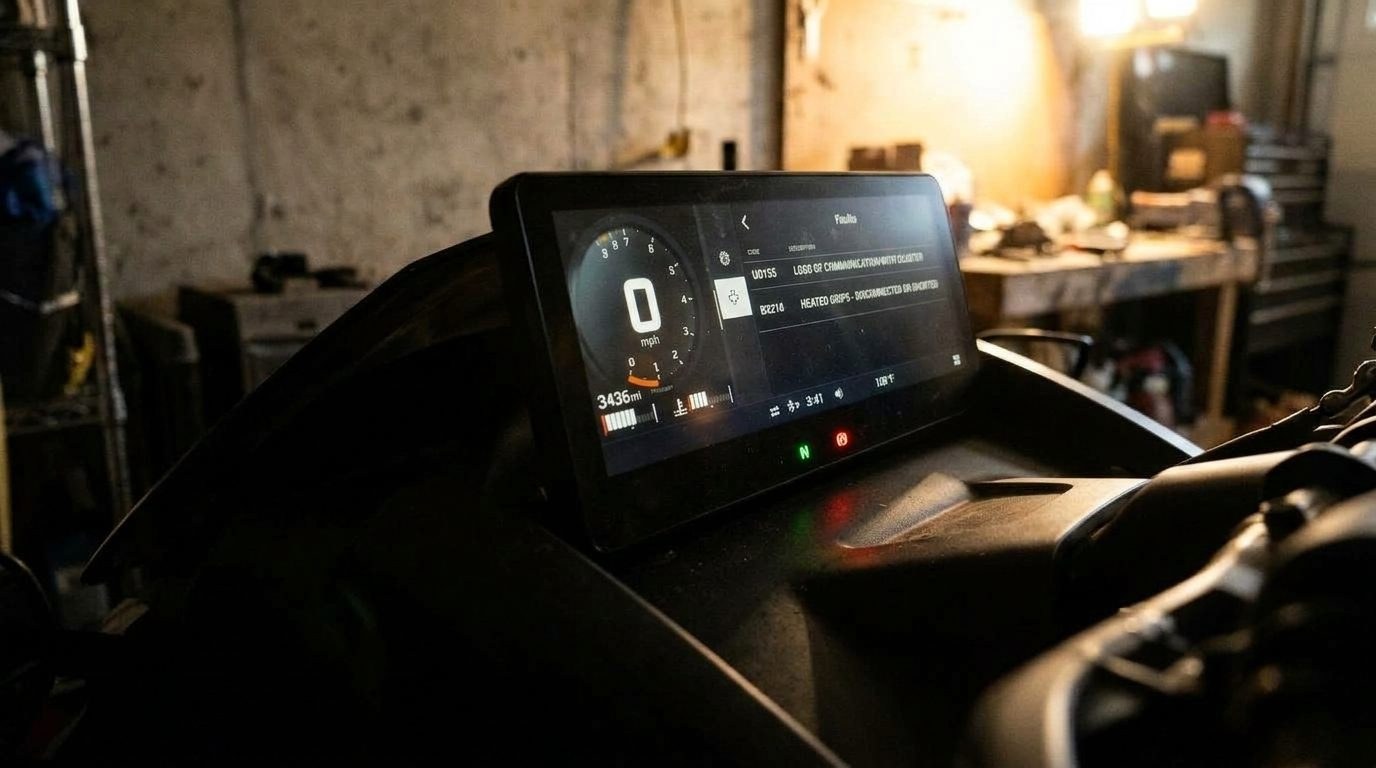
Your Can-Am carries several computers inside: one for the engine, another for the brakes and stability, another for the steering. Each one watches its own sensors and, when something falls outside the normal range, it stores it as a code, one letter and four characters. The letter says where it comes from: P is engine and transmission, C is chassis, meaning brakes, stability and steering, U is the data network that connects those computers to each other, and B is body and equipment. A code does not tell you which part to change: it tells you which signal does not add up, which is where you start looking.
Type in the code you got and we will tell you what it means and where that meaning comes from.
This is an UNOFFICIAL collection of every error code we have been able to gather from various international forums, and that fellow owners have given us with both the code and its meaning. As always, we say that we recommend going to a dealer of the brand in any situation, but that it is also good to know, or to have a reference for, what can be going on with our Can-Am. Lastly, we want to insist that our site only collects information and passes it on to you, and that the decision on what to do is always each owner's own.

You can, without a scan tool, but there is no single way: it changes with the model and the year. What follows is split in two on purpose. First what the manufacturer says in the operator's guides it publishes itself, and then what owners report for the machines that do not have it in the menu.
You may not see the old faults. On many machines the display only shows the ones active right then, and the ones stored in memory are read with the dealer's tool. On the 2019 F3-S the guide says something different: there the codes menu shows the active ones and the ones that have already occurred. So it depends on your machine.
And the warning on the display comes and goes on its own. The 2021 RT guide explains it: the written warning shows for six seconds, disappears for sixty, and during that time the small indicator flashes. That repeats three times and then stops for fifteen minutes, and during those fifteen minutes only the lamps stay on. If it looked to you like the warning cleared itself, this is why.
Where this comes from: the first four points and the two warnings, from the operator's guides the manufacturer publishes (Ryker 2025, Spyder 2019 and Spyder RT 2021). The two points for the older machines, from threads on owners' forums in other countries. If the steps do not work for you, check your machine's manual or ask your dealer.
Nothing matches those words. Try a single word, or browse by group below. If it is a code and it is not here, send it to us and we will look into it.
Search the workshop questions ›
Your code will show up here as soon as you search for it. We do not list all of them: there are 252 and the page would go on forever.
What the code means: A fault in the circuit that heats oxygen sensor number 1.
See the Workshop question where this code comes up
Where this comes from: Two sources that do not depend on each other: the industry wide standard OBD-II table and a Spyder code list put together by an owner. Both say the same thing, so the meaning is solid even though it is not manufacturer documentation.
What the code means: The heater circuit for sensor 1 is open or touching ground.
Where this comes from: Two sources that do not depend on each other: the industry wide standard OBD-II table and a Spyder code list put together by an owner. Both say the same thing, so the meaning is solid even though it is not manufacturer documentation.
What the code means: The heater circuit for sensor 1 is touching the positive side.
Where this comes from: Two sources that do not depend on each other: the industry wide standard OBD-II table and a Spyder code list put together by an owner. Both say the same thing, so the meaning is solid even though it is not manufacturer documentation.
What the code means: A fault in the circuit that heats oxygen sensor number 2.
Where this comes from: Two sources that do not depend on each other: the industry wide standard OBD-II table and a Spyder code list put together by an owner. Both say the same thing, so the meaning is solid even though it is not manufacturer documentation.
What the code means: That sensor's heater circuit is open or touching ground.
Where this comes from: Two sources that do not depend on each other: the industry wide standard OBD-II table and a Spyder code list put together by an owner. Both say the same thing, so the meaning is solid even though it is not manufacturer documentation.
What the code means: The heater circuit for sensor 2 is touching the positive side.
Where this comes from: Two sources that do not depend on each other: the industry wide standard OBD-II table and a Spyder code list put together by an owner. Both say the same thing, so the meaning is solid even though it is not manufacturer documentation.
What the code means: The pressure the manifold sensor reads does not match what the system expects at that moment.
See the 2 Workshop questions where this code comes up
Where this comes from: Standard OBD-II table, the same across the whole industry. This code means the same thing on any vehicle that throws it, so the meaning is solid.
What the code means: The sensor signal comes in below the minimum. It is what you see when the circuit is cut or shorted to ground.
See the 4 Workshop questions where this code comes up
Where this comes from: Standard OBD-II table, the same across the whole industry. This code means the same thing on any vehicle that throws it, so the meaning is solid.
What the code means: The sensor signal comes in above the maximum.
Where this comes from: Standard OBD-II table, the same across the whole industry. This code means the same thing on any vehicle that throws it, so the meaning is solid.
What the code means: That sensor's signal comes in below the accepted range.
In the industry standard table this same number is the intake air temperature sensor. The two sources do not agree.
Where this comes from: A Spyder code list put together by an owner and passed around among enthusiasts. It is not confirmed by the manufacturer and the standard table does not back it, so treat it as a lead, not as a diagnosis.
What the code means: That sensor's signal comes in above the accepted range.
In the industry standard table this same number is the intake air temperature sensor. The two sources do not agree.
See the 2 Workshop questions where this code comes up
Where this comes from: A Spyder code list put together by an owner and passed around among enthusiasts. It is not confirmed by the manufacturer and the standard table does not back it, so treat it as a lead, not as a diagnosis.
What the code means: The temperature the sensor reports does not match what the system expects.
Where this comes from: Two sources that do not depend on each other: the industry wide standard OBD-II table and a Spyder code list put together by an owner. Both say the same thing, so the meaning is solid even though it is not manufacturer documentation.
What the code means: The coolant temperature sensor signal is below the expected range.
Where this comes from: Standard OBD-II table, the same across the whole industry. This code means the same thing on any vehicle that throws it, so the meaning is solid.
What the code means: The coolant temperature sensor signal is above the expected range, or the circuit is open.
See the Workshop question where this code comes up
Where this comes from: Standard OBD-II table, the same across the whole industry. This code means the same thing on any vehicle that throws it, so the meaning is solid.
What the code means: The throttle reading comes in below the range.
See the Workshop question where this code comes up
Where this comes from: Standard OBD-II table, the same across the whole industry. This code means the same thing on any vehicle that throws it, so the meaning is solid.
What the code means: The throttle reading comes in above the range.
Where this comes from: Standard OBD-II table, the same across the whole industry. This code means the same thing on any vehicle that throws it, so the meaning is solid.
What the code means: The air entering the engine is hotter than allowed.
Where this comes from: Two sources that do not depend on each other: the industry wide standard OBD-II table and a Spyder code list put together by an owner. Both say the same thing, so the meaning is solid even though it is not manufacturer documentation.
What the code means: A fault in the oxygen sensor fitted before the catalyst.
See the Workshop question where this code comes up
Where this comes from: Two sources that do not depend on each other: the industry wide standard OBD-II table and a Spyder code list put together by an owner. Both say the same thing, so the meaning is solid even though it is not manufacturer documentation.
What the code means: That sensor's circuit is open or touching ground.
Where this comes from: Two sources that do not depend on each other: the industry wide standard OBD-II table and a Spyder code list put together by an owner. Both say the same thing, so the meaning is solid even though it is not manufacturer documentation.
What the code means: That sensor's circuit is touching the positive side.
Where this comes from: Two sources that do not depend on each other: the industry wide standard OBD-II table and a Spyder code list put together by an owner. Both say the same thing, so the meaning is solid even though it is not manufacturer documentation.
What the code means: The sensor takes longer than normal to react to changes.
Where this comes from: Two sources that do not depend on each other: the industry wide standard OBD-II table and a Spyder code list put together by an owner. Both say the same thing, so the meaning is solid even though it is not manufacturer documentation.
What the code means: A fault in that sensor's heater circuit.
See the Workshop question where this code comes up
Where this comes from: Two sources that do not depend on each other: the industry wide standard OBD-II table and a Spyder code list put together by an owner. Both say the same thing, so the meaning is solid even though it is not manufacturer documentation.
What the code means: A fault in the second oxygen sensor.
See the Workshop question where this code comes up
Where this comes from: Two sources that do not depend on each other: the industry wide standard OBD-II table and a Spyder code list put together by an owner. Both say the same thing, so the meaning is solid even though it is not manufacturer documentation.
What the code means: That sensor's circuit is open or touching ground.
Where this comes from: Two sources that do not depend on each other: the industry wide standard OBD-II table and a Spyder code list put together by an owner. Both say the same thing, so the meaning is solid even though it is not manufacturer documentation.
What the code means: That sensor's circuit is touching the positive side.
Where this comes from: Two sources that do not depend on each other: the industry wide standard OBD-II table and a Spyder code list put together by an owner. Both say the same thing, so the meaning is solid even though it is not manufacturer documentation.
What the code means: The second sensor takes longer than normal to react.
Where this comes from: Two sources that do not depend on each other: the industry wide standard OBD-II table and a Spyder code list put together by an owner. Both say the same thing, so the meaning is solid even though it is not manufacturer documentation.
What the code means: A fault in the second sensor's heater circuit.
Where this comes from: Two sources that do not depend on each other: the industry wide standard OBD-II table and a Spyder code list put together by an owner. Both say the same thing, so the meaning is solid even though it is not manufacturer documentation.
What the code means: The engine is running with too little fuel for the air coming in.
See the Workshop question where this code comes up
Where this comes from: Two sources that do not depend on each other: the industry wide standard OBD-II table and a Spyder code list put together by an owner. Both say the same thing, so the meaning is solid even though it is not manufacturer documentation.
What the code means: The engine is running with too much fuel for the air coming in.
See the Workshop question where this code comes up
Where this comes from: Two sources that do not depend on each other: the industry wide standard OBD-II table and a Spyder code list put together by an owner. Both say the same thing, so the meaning is solid even though it is not manufacturer documentation.
What the code means: The same as the previous one, on the second bank of cylinders.
Where this comes from: Two sources that do not depend on each other: the industry wide standard OBD-II table and a Spyder code list put together by an owner. Both say the same thing, so the meaning is solid even though it is not manufacturer documentation.
What the code means: A fault in the part of the control unit that drives injector 2.
Where this comes from: Two sources that do not depend on each other: the industry wide standard OBD-II table and a Spyder code list put together by an owner. Both say the same thing, so the meaning is solid even though it is not manufacturer documentation.
What the code means: A fault in the part of the control unit that drives injector 1.
Where this comes from: Two sources that do not depend on each other: the industry wide standard OBD-II table and a Spyder code list put together by an owner. Both say the same thing, so the meaning is solid even though it is not manufacturer documentation.
What the code means: The coolant has gone past the allowed temperature.
Where this comes from: Two sources that do not depend on each other: the industry wide standard OBD-II table and a Spyder code list put together by an owner. Both say the same thing, so the meaning is solid even though it is not manufacturer documentation.
What the code means: The second throttle control sensor is touching ground.
Where this comes from: Two sources that do not depend on each other: the industry wide standard OBD-II table and a Spyder code list put together by an owner. Both say the same thing, so the meaning is solid even though it is not manufacturer documentation.
What the code means: The second throttle control sensor is touching the positive side.
See the Workshop question where this code comes up
Where this comes from: Two sources that do not depend on each other: the industry wide standard OBD-II table and a Spyder code list put together by an owner. Both say the same thing, so the meaning is solid even though it is not manufacturer documentation.
What the code means: Voltage in the fuel pump secondary circuit is below what is expected.
Where this comes from: Standard OBD-II table, the same across the whole industry. This code means the same thing on any vehicle that throws it, so the meaning is solid.
What the code means: Voltage in the fuel pump circuit is above what is expected.
Where this comes from: Standard OBD-II table, the same across the whole industry. This code means the same thing on any vehicle that throws it, so the meaning is solid.
What the code means: The cylinder 1 injector circuit is open or touching ground.
Where this comes from: Two sources that do not depend on each other: the industry wide standard OBD-II table and a Spyder code list put together by an owner. Both say the same thing, so the meaning is solid even though it is not manufacturer documentation.
What the code means: The cylinder 1 injector circuit is touching the positive side.
Where this comes from: Two sources that do not depend on each other: the industry wide standard OBD-II table and a Spyder code list put together by an owner. Both say the same thing, so the meaning is solid even though it is not manufacturer documentation.
What the code means: The cylinder 2 injector circuit is open or touching ground.
Where this comes from: Two sources that do not depend on each other: the industry wide standard OBD-II table and a Spyder code list put together by an owner. Both say the same thing, so the meaning is solid even though it is not manufacturer documentation.
What the code means: The cylinder 2 injector circuit is touching the positive side.
Where this comes from: Two sources that do not depend on each other: the industry wide standard OBD-II table and a Spyder code list put together by an owner. Both say the same thing, so the meaning is solid even though it is not manufacturer documentation.
What the code means: The system detects misfires without being able to pin them to one cylinder.
A misfire shows up on the road: the machine vibrates and loses power.
Where this comes from: Standard OBD-II table, the same across the whole industry. This code means the same thing on any vehicle that throws it, so the meaning is solid.
What the code means: The system detects misfires on cylinder 1.
See the Workshop question where this code comes up
Where this comes from: Standard OBD-II table, the same across the whole industry. This code means the same thing on any vehicle that throws it, so the meaning is solid.
What the code means: The system detects misfires on cylinder 2.
Where this comes from: Standard OBD-II table, the same across the whole industry. This code means the same thing on any vehicle that throws it, so the meaning is solid.
What the code means: The system detects misfires on cylinder 3, on the machines that have one.
Where this comes from: Standard OBD-II table, the same across the whole industry. This code means the same thing on any vehicle that throws it, so the meaning is solid.
What the code means: A fault in the first knock sensor.
Where this comes from: Two sources that do not depend on each other: the industry wide standard OBD-II table and a Spyder code list put together by an owner. Both say the same thing, so the meaning is solid even though it is not manufacturer documentation.
What the code means: A fault in the negative line of the first knock sensor.
Where this comes from: Two sources that do not depend on each other: the industry wide standard OBD-II table and a Spyder code list put together by an owner. Both say the same thing, so the meaning is solid even though it is not manufacturer documentation.
What the code means: A fault in the positive line of the first knock sensor.
Where this comes from: Two sources that do not depend on each other: the industry wide standard OBD-II table and a Spyder code list put together by an owner. Both say the same thing, so the meaning is solid even though it is not manufacturer documentation.
What the code means: A fault in the second knock sensor.
Where this comes from: A Spyder code list put together by an owner and passed around among enthusiasts. It is not confirmed by the manufacturer and the standard table does not back it, so treat it as a lead, not as a diagnosis.
What the code means: A fault in the negative line of the second knock sensor.
Where this comes from: Two sources that do not depend on each other: the industry wide standard OBD-II table and a Spyder code list put together by an owner. Both say the same thing, so the meaning is solid even though it is not manufacturer documentation.
What the code means: A fault in the positive line of the second knock sensor.
Where this comes from: Two sources that do not depend on each other: the industry wide standard OBD-II table and a Spyder code list put together by an owner. Both say the same thing, so the meaning is solid even though it is not manufacturer documentation.
What the code means: The system is not getting the signal that tells it the engine is turning.
Without that signal the engine cannot run, so the machine stops or never starts.
See the Workshop question where this code comes up
Where this comes from: Standard OBD-II table, the same across the whole industry. This code means the same thing on any vehicle that throws it, so the meaning is solid.
What the code means: The list calls this code the crankshaft position sensor; in the standard table it is the camshaft one.
In the industry standard table this same number is the camshaft position sensor. The two sources do not agree.
See the 3 Workshop questions where this code comes up
Where this comes from: A Spyder code list put together by an owner and passed around among enthusiasts. It is not confirmed by the manufacturer and the standard table does not back it, so treat it as a lead, not as a diagnosis.
What the code means: There is a fault in the first ignition coil circuit.
In several cases reported on the forums the culprit was not the coil, but the engine module or a cracked spark plug.
See the Workshop question where this code comes up
Where this comes from: Standard OBD-II table, the same across the whole industry. This code means the same thing on any vehicle that throws it, so the meaning is solid.
What the code means: The same as the previous one, on the second coil.
See the 2 Workshop questions where this code comes up
Where this comes from: Standard OBD-II table, the same across the whole industry. This code means the same thing on any vehicle that throws it, so the meaning is solid.
What the code means: A fault in an ignition coil.
Where this comes from: Two sources that do not depend on each other: the industry wide standard OBD-II table and a Spyder code list put together by an owner. Both say the same thing, so the meaning is solid even though it is not manufacturer documentation.
What the code means: A fault in the valve that handles the fuel tank vapours.
Where this comes from: Two sources that do not depend on each other: the industry wide standard OBD-II table and a Spyder code list put together by an owner. Both say the same thing, so the meaning is solid even though it is not manufacturer documentation.
What the code means: That valve's circuit is open or touching ground.
Where this comes from: Two sources that do not depend on each other: the industry wide standard OBD-II table and a Spyder code list put together by an owner. Both say the same thing, so the meaning is solid even though it is not manufacturer documentation.
What the code means: That valve's circuit is touching the positive side.
Where this comes from: Two sources that do not depend on each other: the industry wide standard OBD-II table and a Spyder code list put together by an owner. Both say the same thing, so the meaning is solid even though it is not manufacturer documentation.
What the code means: There is a fault in the circuit that drives the radiator fan.
Where this comes from: Standard OBD-II table, the same across the whole industry. We have not found any Can-Am document confirming it on these machines, so the general meaning holds, but we cannot vouch for the specific detail.
What the code means: The speed the system reads does not match the rest of the data.
Where this comes from: Two sources that do not depend on each other: the industry wide standard OBD-II table and a Spyder code list put together by an owner. Both say the same thing, so the meaning is solid even though it is not manufacturer documentation.
What the code means: A fault in the oil pressure sensor circuit.
Where this comes from: Two sources that do not depend on each other: the industry wide standard OBD-II table and a Spyder code list put together by an owner. Both say the same thing, so the meaning is solid even though it is not manufacturer documentation.
What the code means: The sensor sticks at one value instead of following the real pressure.
Where this comes from: Two sources that do not depend on each other: the industry wide standard OBD-II table and a Spyder code list put together by an owner. Both say the same thing, so the meaning is solid even though it is not manufacturer documentation.
What the code means: The oil pressure is below the accepted level.
See the Workshop question where this code comes up
Where this comes from: Two sources that do not depend on each other: the industry wide standard OBD-II table and a Spyder code list put together by an owner. Both say the same thing, so the meaning is solid even though it is not manufacturer documentation.
What the code means: The internal memory check of the engine control module does not come out right.
This is a P family code, which is the engine family. It has nothing to do with the power steering.
Where this comes from: Standard OBD-II table, the same across the whole industry. This code means the same thing on any vehicle that throws it, so the meaning is solid.
What the code means: The engine control module is not programmed as it should be.
Where this comes from: Standard OBD-II table, the same across the whole industry. This code means the same thing on any vehicle that throws it, so the meaning is solid.
What the code means: The read only memory check of the engine control module fails.
An owner of a 2013 Spyder had it stored and it cleared after updating the engine module software.
Where this comes from: Standard OBD-II table, the same across the whole industry. This code means the same thing on any vehicle that throws it, so the meaning is solid.
What the code means: A fault in the control unit's own processor.
Where this comes from: Two sources that do not depend on each other: the industry wide standard OBD-II table and a Spyder code list put together by an owner. Both say the same thing, so the meaning is solid even though it is not manufacturer documentation.
What the code means: The two throttle control sensors are not saying the same thing.
Where this comes from: A Spyder code list put together by an owner and passed around among enthusiasts. It is not confirmed by the manufacturer and the standard table does not back it, so treat it as a lead, not as a diagnosis.
What the code means: The throttle position does not respond the way the system expects.
Where this comes from: A Spyder code list put together by an owner and passed around among enthusiasts. It is not confirmed by the manufacturer and the standard table does not back it, so treat it as a lead, not as a diagnosis.
What the code means: The control unit does not have this machine's configuration recorded correctly.
Where this comes from: Two sources that do not depend on each other: the industry wide standard OBD-II table and a Spyder code list put together by an owner. Both say the same thing, so the meaning is solid even though it is not manufacturer documentation.
What the code means: A fault in the memory where the control unit keeps its settings.
Where this comes from: A Spyder code list put together by an owner and passed around among enthusiasts. It is not confirmed by the manufacturer and the standard table does not back it, so treat it as a lead, not as a diagnosis.
What the code means: The fan circuit is open or touching ground.
Where this comes from: Two sources that do not depend on each other: the industry wide standard OBD-II table and a Spyder code list put together by an owner. Both say the same thing, so the meaning is solid even though it is not manufacturer documentation.
What the code means: The fan circuit is touching the positive side.
Where this comes from: Two sources that do not depend on each other: the industry wide standard OBD-II table and a Spyder code list put together by an owner. Both say the same thing, so the meaning is solid even though it is not manufacturer documentation.
What the code means: The signal from that sensor's heater circuit is not what was expected.
See the Workshop question where this code comes up
Where this comes from: A Spyder code list put together by an owner and passed around among enthusiasts. It is not confirmed by the manufacturer and the standard table does not back it, so treat it as a lead, not as a diagnosis.
What the code means: The list repeats the same text here as for the previous code, so it does not tell them apart.
See the Workshop question where this code comes up
Where this comes from: A Spyder code list put together by an owner and passed around among enthusiasts. It is not confirmed by the manufacturer and the standard table does not back it, so treat it as a lead, not as a diagnosis.
What the code means: The position read from the throttle control sensor is not the right one.
Where this comes from: A Spyder code list put together by an owner and passed around among enthusiasts. It is not confirmed by the manufacturer and the standard table does not back it, so treat it as a lead, not as a diagnosis.
What the code means: The signal from the first oxygen sensor is not what was expected.
Where this comes from: A Spyder code list put together by an owner and passed around among enthusiasts. It is not confirmed by the manufacturer and the standard table does not back it, so treat it as a lead, not as a diagnosis.
What the code means: The second sensor's signal comes and goes or jumps around.
Where this comes from: A Spyder code list put together by an owner and passed around among enthusiasts. It is not confirmed by the manufacturer and the standard table does not back it, so treat it as a lead, not as a diagnosis.
What the code means: The list gives this code the same meaning as P0171.
Where this comes from: A Spyder code list put together by an owner and passed around among enthusiasts. It is not confirmed by the manufacturer and the standard table does not back it, so treat it as a lead, not as a diagnosis.
What the code means: The list gives this code the same meaning as P0172.
See the Workshop question where this code comes up
Where this comes from: A Spyder code list put together by an owner and passed around among enthusiasts. It is not confirmed by the manufacturer and the standard table does not back it, so treat it as a lead, not as a diagnosis.
What the code means: The list gives this code the same meaning as P0174.
See the 2 Workshop questions where this code comes up
Where this comes from: A Spyder code list put together by an owner and passed around among enthusiasts. It is not confirmed by the manufacturer and the standard table does not back it, so treat it as a lead, not as a diagnosis.
What the code means: The list gives this code the same meaning as P0175.
See the Workshop question where this code comes up
Where this comes from: A Spyder code list put together by an owner and passed around among enthusiasts. It is not confirmed by the manufacturer and the standard table does not back it, so treat it as a lead, not as a diagnosis.
What the code means: The list gives this code the same meaning as P0327.
Where this comes from: A Spyder code list put together by an owner and passed around among enthusiasts. It is not confirmed by the manufacturer and the standard table does not back it, so treat it as a lead, not as a diagnosis.
What the code means: The list gives this code the same meaning as P0328.
Where this comes from: A Spyder code list put together by an owner and passed around among enthusiasts. It is not confirmed by the manufacturer and the standard table does not back it, so treat it as a lead, not as a diagnosis.
What the code means: The list gives this code the same meaning as P0332.
Where this comes from: A Spyder code list put together by an owner and passed around among enthusiasts. It is not confirmed by the manufacturer and the standard table does not back it, so treat it as a lead, not as a diagnosis.
What the code means: A fault in the positive line of the second knock sensor.
Where this comes from: A Spyder code list put together by an owner and passed around among enthusiasts. It is not confirmed by the manufacturer and the standard table does not back it, so treat it as a lead, not as a diagnosis.
What the code means: The list gives this code the same meaning as P0606.
Where this comes from: A Spyder code list put together by an owner and passed around among enthusiasts. It is not confirmed by the manufacturer and the standard table does not back it, so treat it as a lead, not as a diagnosis.
What the code means: The throttle actuator circuit is touching the positive side.
Where this comes from: A Spyder code list put together by an owner and passed around among enthusiasts. It is not confirmed by the manufacturer and the standard table does not back it, so treat it as a lead, not as a diagnosis.
What the code means: The throttle actuator circuit is touching ground.
Where this comes from: A Spyder code list put together by an owner and passed around among enthusiasts. It is not confirmed by the manufacturer and the standard table does not back it, so treat it as a lead, not as a diagnosis.
What the code means: In the list this code carries a typing error, so it cannot be read with any certainty whether it says shorted to ground or the opposite.
Where this comes from: A Spyder code list put together by an owner and passed around among enthusiasts. It is not confirmed by the manufacturer and the standard table does not back it, so treat it as a lead, not as a diagnosis.
What the code means: What the actuator does not match what it was asked to do.
Where this comes from: A Spyder code list put together by an owner and passed around among enthusiasts. It is not confirmed by the manufacturer and the standard table does not back it, so treat it as a lead, not as a diagnosis.
What the code means: The list assigns this code to the throttle actuator, without saying what is wrong with it.
Where this comes from: A Spyder code list put together by an owner and passed around among enthusiasts. It is not confirmed by the manufacturer and the standard table does not back it, so treat it as a lead, not as a diagnosis.
What the code means: When the throttle is released, the butterfly does not reach the idle position.
See the 3 Workshop questions where this code comes up
Where this comes from: A Spyder code list put together by an owner and passed around among enthusiasts. It is not confirmed by the manufacturer and the standard table does not back it, so treat it as a lead, not as a diagnosis.
What the code means: The position the sensor gives drifts from the one it should give.
Where this comes from: A Spyder code list put together by an owner and passed around among enthusiasts. It is not confirmed by the manufacturer and the standard table does not back it, so treat it as a lead, not as a diagnosis.
What the code means: The throttle cannot reach its limp home position.
Where this comes from: A Spyder code list put together by an owner and passed around among enthusiasts. It is not confirmed by the manufacturer and the standard table does not back it, so treat it as a lead, not as a diagnosis.
What the code means: The throttle sensor does not complete its adaptation process.
Where this comes from: A Spyder code list put together by an owner and passed around among enthusiasts. It is not confirmed by the manufacturer and the standard table does not back it, so treat it as a lead, not as a diagnosis.
What the code means: The list repeats the same text here as for the previous code, so it does not tell them apart.
Where this comes from: A Spyder code list put together by an owner and passed around among enthusiasts. It is not confirmed by the manufacturer and the standard table does not back it, so treat it as a lead, not as a diagnosis.
What the code means: The adaptation stops because the lower mechanical stop does not respond.
Where this comes from: A Spyder code list put together by an owner and passed around among enthusiasts. It is not confirmed by the manufacturer and the standard table does not back it, so treat it as a lead, not as a diagnosis.
What the code means: The adaptation process ends in failure.
Where this comes from: A Spyder code list put together by an owner and passed around among enthusiasts. It is not confirmed by the manufacturer and the standard table does not back it, so treat it as a lead, not as a diagnosis.
What the code means: The control unit fails one of its own internal reading checks.
Where this comes from: A Spyder code list put together by an owner and passed around among enthusiasts. It is not confirmed by the manufacturer and the standard table does not back it, so treat it as a lead, not as a diagnosis.
What the code means: A test the control unit runs on itself has come out bad.
Where this comes from: A Spyder code list put together by an owner and passed around among enthusiasts. It is not confirmed by the manufacturer and the standard table does not back it, so treat it as a lead, not as a diagnosis.
What the code means: The control unit's internal monitoring system reports an error.
Where this comes from: A Spyder code list put together by an owner and passed around among enthusiasts. It is not confirmed by the manufacturer and the standard table does not back it, so treat it as a lead, not as a diagnosis.
What the code means: The monitoring check on the throttle control sensors does not pass.
Where this comes from: A Spyder code list put together by an owner and passed around among enthusiasts. It is not confirmed by the manufacturer and the standard table does not back it, so treat it as a lead, not as a diagnosis.
What the code means: The monitoring check on engine speed does not pass.
Where this comes from: A Spyder code list put together by an owner and passed around among enthusiasts. It is not confirmed by the manufacturer and the standard table does not back it, so treat it as a lead, not as a diagnosis.
What the code means: The control unit has cut the fuel for safety, at its first level.
Where this comes from: A Spyder code list put together by an owner and passed around among enthusiasts. It is not confirmed by the manufacturer and the standard table does not back it, so treat it as a lead, not as a diagnosis.
What the code means: The control unit has cut the fuel for safety, at its second level.
Where this comes from: A Spyder code list put together by an owner and passed around among enthusiasts. It is not confirmed by the manufacturer and the standard table does not back it, so treat it as a lead, not as a diagnosis.
What the code means: The throttle valve does not pass the plausibility check.
Where this comes from: A Spyder code list put together by an owner and passed around among enthusiasts. It is not confirmed by the manufacturer and the standard table does not back it, so treat it as a lead, not as a diagnosis.
What the code means: The throttle opens further than the monitoring allows.
See the Workshop question where this code comes up
Where this comes from: A Spyder code list put together by an owner and passed around among enthusiasts. It is not confirmed by the manufacturer and the standard table does not back it, so treat it as a lead, not as a diagnosis.
What the code means: The second throttle sensor signal comes in below the accepted range.
Where this comes from: A Spyder code list put together by an owner and passed around among enthusiasts. It is not confirmed by the manufacturer and the standard table does not back it, so treat it as a lead, not as a diagnosis.
What the code means: The second throttle sensor signal comes in above the accepted range.
Where this comes from: A Spyder code list put together by an owner and passed around among enthusiasts. It is not confirmed by the manufacturer and the standard table does not back it, so treat it as a lead, not as a diagnosis.
What the code means: The list gives this code the same meaning as P0501.
See the Workshop question where this code comes up
Where this comes from: A Spyder code list put together by an owner and passed around among enthusiasts. It is not confirmed by the manufacturer and the standard table does not back it, so treat it as a lead, not as a diagnosis.
What the code means: That sensor's circuit is touching ground.
See the 2 Workshop questions where this code comes up
Where this comes from: A Spyder code list put together by an owner and passed around among enthusiasts. It is not confirmed by the manufacturer and the standard table does not back it, so treat it as a lead, not as a diagnosis.
What the code means: That sensor's circuit is touching the positive side.
Where this comes from: A Spyder code list put together by an owner and passed around among enthusiasts. It is not confirmed by the manufacturer and the standard table does not back it, so treat it as a lead, not as a diagnosis.
What the code means: Air is getting into the engine where it should not.
See the 2 Workshop questions where this code comes up
Where this comes from: A Spyder code list put together by an owner and passed around among enthusiasts. It is not confirmed by the manufacturer and the standard table does not back it, so treat it as a lead, not as a diagnosis.
What the code means: The two oxygen sensors have their signals crossed over.
Where this comes from: A Spyder code list put together by an owner and passed around among enthusiasts. It is not confirmed by the manufacturer and the standard table does not back it, so treat it as a lead, not as a diagnosis.
What the code means: A fault in the position reported by the throttle control sensors.
Where this comes from: A Spyder code list put together by an owner and passed around among enthusiasts. It is not confirmed by the manufacturer and the standard table does not back it, so treat it as a lead, not as a diagnosis.
What the code means: The first throttle sensor signal comes in below the accepted range.
Where this comes from: A Spyder code list put together by an owner and passed around among enthusiasts. It is not confirmed by the manufacturer and the standard table does not back it, so treat it as a lead, not as a diagnosis.
What the code means: The first throttle sensor signal comes in above the accepted range.
Where this comes from: A Spyder code list put together by an owner and passed around among enthusiasts. It is not confirmed by the manufacturer and the standard table does not back it, so treat it as a lead, not as a diagnosis.
What the code means: There is a fault in the circuit of the anti lock braking system pump motor.
Where this comes from: Standard OBD-II table, the same across the whole industry. We have not found any Can-Am document confirming it on these machines, so the general meaning holds, but we cannot vouch for the specific detail.
What the code means: The system is not getting a good speed signal from the left front wheel.
It is quoted in those words on the forums, and also on a Ryker after a front fender was replaced.
See the 2 Workshop questions where this code comes up
Where this comes from: Threads on owners' forums from other countries. It is not official documentation from the manufacturer. see the document.
What the code means: A failure in the sensor that measures how fast the left front wheel turns.
Where this comes from: A Spyder code list put together by an owner and passed around among enthusiasts. It is not confirmed by the manufacturer and the standard table does not back it, so treat it as a lead, not as a diagnosis.
What the code means: The system is not getting a good speed signal from the right front wheel.
It often comes up together with the left wheel one when the trouble is with both front sensors.
See the 2 Workshop questions where this code comes up
Where this comes from: Threads on owners' forums from other countries. It is not official documentation from the manufacturer. see the document.
What the code means: A failure in the sensor that measures how fast the right front wheel turns.
Where this comes from: A Spyder code list put together by an owner and passed around among enthusiasts. It is not confirmed by the manufacturer and the standard table does not back it, so treat it as a lead, not as a diagnosis.
What the code means: A failure in the sensor that measures how fast the rear wheel turns.
See the 4 Workshop questions where this code comes up
Where this comes from: A Spyder code list put together by an owner and passed around among enthusiasts. It is not confirmed by the manufacturer and the standard table does not back it, so treat it as a lead, not as a diagnosis.
What the code means: A failure in the electrical supply reaching that sensor.
Where this comes from: A Spyder code list put together by an owner and passed around among enthusiasts. It is not confirmed by the manufacturer and the standard table does not back it, so treat it as a lead, not as a diagnosis.
What the code means: BRP says it in these words in two service bulletins: the diagnostic tool returns C0040 when the brake light switch fails. The cause the manufacturer gives is the adjustment of that switch.
Watch out with this one, because it is the easiest trap: if you look it up yourself, plenty of tables say C0040 is the right front wheel speed sensor. That is true on other makes. On a Can-Am what BRP says is what counts. It usually comes up alongside P061E, P0504, C0042 or C1182.
See the 5 Workshop questions where this code comes up
Where this comes from: Service bulletins from BRP itself, published in the open by the United States road safety agency. It is the best source there is: the manufacturer speaking. see the document.
What the code means: This is the switch that checks the brake circuit pressure rises as it should. BRP lists it alongside C0040.
See the Workshop question where this code comes up
Where this comes from: Service bulletins from BRP itself, published in the open by the United States road safety agency. It is the best source there is: the manufacturer speaking. see the document.
What the code means: The list gives this code for both parts, without separating them.
See the Workshop question where this code comes up
Where this comes from: A Spyder code list put together by an owner and passed around among enthusiasts. It is not confirmed by the manufacturer and the standard table does not back it, so treat it as a lead, not as a diagnosis.
What the code means: A brake system failure related to the fluid.
See the 2 Workshop questions where this code comes up
Where this comes from: A Spyder code list put together by an owner and passed around among enthusiasts. It is not confirmed by the manufacturer and the standard table does not back it, so treat it as a lead, not as a diagnosis.
What the code means: The system does not accept the handlebar position it is reading.
Where this comes from: A Spyder code list put together by an owner and passed around among enthusiasts. It is not confirmed by the manufacturer and the standard table does not back it, so treat it as a lead, not as a diagnosis.
What the code means: A failure in the sensor that measures the force pushing the machine sideways.
Where this comes from: A Spyder code list put together by an owner and passed around among enthusiasts. It is not confirmed by the manufacturer and the standard table does not back it, so treat it as a lead, not as a diagnosis.
What the code means: A failure in the sensor that measures acceleration and braking front to back.
Where this comes from: A Spyder code list put together by an owner and passed around among enthusiasts. It is not confirmed by the manufacturer and the standard table does not back it, so treat it as a lead, not as a diagnosis.
What the code means: A failure in the sensor that measures how much the machine is rotating about itself.
See the 3 Workshop questions where this code comes up
Where this comes from: A Spyder code list put together by an owner and passed around among enthusiasts. It is not confirmed by the manufacturer and the standard table does not back it, so treat it as a lead, not as a diagnosis.
What the code means: It is logged when the machine is run on a roller bench in a way the system does not accept.
Where this comes from: A Spyder code list put together by an owner and passed around among enthusiasts. It is not confirmed by the manufacturer and the standard table does not back it, so treat it as a lead, not as a diagnosis.
What the code means: The switch that detects the passenger is in contact with the positive side.
Where this comes from: A Spyder code list put together by an owner and passed around among enthusiasts. It is not confirmed by the manufacturer and the standard table does not back it, so treat it as a lead, not as a diagnosis.
What the code means: The list puts both the control unit overheating and the inlet and outlet valve coil fault under this code.
Where this comes from: A Spyder code list put together by an owner and passed around among enthusiasts. It is not confirmed by the manufacturer and the standard table does not back it, so treat it as a lead, not as a diagnosis.
What the code means: The steering angle sensor has not been calibrated.
Where this comes from: A Spyder code list put together by an owner and passed around among enthusiasts. It is not confirmed by the manufacturer and the standard table does not back it, so treat it as a lead, not as a diagnosis.
What the code means: The longitudinal acceleration sensor has not been calibrated.
Where this comes from: A Spyder code list put together by an owner and passed around among enthusiasts. It is not confirmed by the manufacturer and the standard table does not back it, so treat it as a lead, not as a diagnosis.
What the code means: There is a wheel speed sensor fault, but the code does not say which one.
Where this comes from: A Spyder code list put together by an owner and passed around among enthusiasts. It is not confirmed by the manufacturer and the standard table does not back it, so treat it as a lead, not as a diagnosis.
What the code means: BRP lists it in the same block as C0040, on Spyder RT from 2020 on and Ryker from 2019 on.
It is not the same as C1282, however alike they look: they are different numbers and turn up on different machines.
See the Workshop question where this code comes up
Where this comes from: Service bulletins from BRP itself, published in the open by the United States road safety agency. It is the best source there is: the manufacturer speaking. see the document.
What the code means: The switch that detects the passenger is in contact with ground.
Where this comes from: A Spyder code list put together by an owner and passed around among enthusiasts. It is not confirmed by the manufacturer and the standard table does not back it, so treat it as a lead, not as a diagnosis.
What the code means: A voltage fault in the brake and stability module.
Where this comes from: A Spyder code list put together by an owner and passed around among enthusiasts. It is not confirmed by the manufacturer and the standard table does not back it, so treat it as a lead, not as a diagnosis.
What the code means: A fault affecting the anti lock braking system valves.
Where this comes from: A Spyder code list put together by an owner and passed around among enthusiasts. It is not confirmed by the manufacturer and the standard table does not back it, so treat it as a lead, not as a diagnosis.
What the code means: A fault affecting the cut valves in the hydraulic unit.
Where this comes from: A Spyder code list put together by an owner and passed around among enthusiasts. It is not confirmed by the manufacturer and the standard table does not back it, so treat it as a lead, not as a diagnosis.
What the code means: A fault affecting the suction valves in the hydraulic unit.
Where this comes from: A Spyder code list put together by an owner and passed around among enthusiasts. It is not confirmed by the manufacturer and the standard table does not back it, so treat it as a lead, not as a diagnosis.
What the code means: The module detects that its own control does not match what it expected.
Where this comes from: A Spyder code list put together by an owner and passed around among enthusiasts. It is not confirmed by the manufacturer and the standard table does not back it, so treat it as a lead, not as a diagnosis.
What the code means: The module does not have the right configuration recorded for this machine.
Where this comes from: A Spyder code list put together by an owner and passed around among enthusiasts. It is not confirmed by the manufacturer and the standard table does not back it, so treat it as a lead, not as a diagnosis.
What the code means: It compares circuit pressure against how far the pedal has travelled: if the pressure has not risen enough by that point, the code trips. There are two switches on the pedal linkage, and this is the second one, the low pressure switch, not the brake light one.
A long time owner explains it in detail on a 2012 Spyder RT. He adds that the code sticks and has to be cleared, and that in his experience it is nearly always overdue maintenance, such as old fluid or worn pads.
See the 4 Workshop questions where this code comes up
Where this comes from: Threads on owners' forums from other countries. It is not official documentation from the manufacturer. see the document.
What the code means: The signal from that switch is outside the accepted values.
Where this comes from: A Spyder code list put together by an owner and passed around among enthusiasts. It is not confirmed by the manufacturer and the standard table does not back it, so treat it as a lead, not as a diagnosis.
What the code means: The voltage reaching the module is too far above or below range.
See the 2 Workshop questions where this code comes up
Where this comes from: A Spyder code list put together by an owner and passed around among enthusiasts. It is not confirmed by the manufacturer and the standard table does not back it, so treat it as a lead, not as a diagnosis.
What the code means: The module itself detects a fault inside itself.
Where this comes from: A Spyder code list put together by an owner and passed around among enthusiasts. It is not confirmed by the manufacturer and the standard table does not back it, so treat it as a lead, not as a diagnosis.
What the code means: The signal coming from the brake does not match what the system expects. BRP lists it in the same block as C0040.
See the 2 Workshop questions where this code comes up
Where this comes from: Service bulletins from BRP itself, published in the open by the United States road safety agency. It is the best source there is: the manufacturer speaking. see the document.
What the code means: BRP lists it alongside C0040 in the same block of codes that come up when the brake signal is not right.
See the Workshop question where this code comes up
Where this comes from: Service bulletins from BRP itself, published in the open by the United States road safety agency. It is the best source there is: the manufacturer speaking. see the document.
What the code means: The sensor that measures how far you turn the handlebar is not adapting properly.
See the Workshop question where this code comes up
Where this comes from: A Spyder code list put together by an owner and passed around among enthusiasts. It is not confirmed by the manufacturer and the standard table does not back it, so treat it as a lead, not as a diagnosis.
What the code means: The circuit of the sensor that measures the force you apply at the handlebar is open.
In the industry standard table this same number is the power steering pressure sensor. The two sources do not agree.
See the 2 Workshop questions where this code comes up
Where this comes from: A Spyder code list put together by an owner and passed around among enthusiasts. It is not confirmed by the manufacturer and the standard table does not back it, so treat it as a lead, not as a diagnosis.
What the code means: That circuit is touching ground.
In the industry standard table this same number is the power steering pressure sensor. The two sources do not agree.
See the 2 Workshop questions where this code comes up
Where this comes from: A Spyder code list put together by an owner and passed around among enthusiasts. It is not confirmed by the manufacturer and the standard table does not back it, so treat it as a lead, not as a diagnosis.
What the code means: That circuit is touching the 5 volt line.
In the industry standard table this same number is the power steering pressure sensor. The two sources do not agree.
Where this comes from: A Spyder code list put together by an owner and passed around among enthusiasts. It is not confirmed by the manufacturer and the standard table does not back it, so treat it as a lead, not as a diagnosis.
What the code means: The steering module has had to step in more times than it allows.
In the industry standard table this same number is the power steering pressure sensor. The two sources do not agree.
Where this comes from: A Spyder code list put together by an owner and passed around among enthusiasts. It is not confirmed by the manufacturer and the standard table does not back it, so treat it as a lead, not as a diagnosis.
What the code means: Less current than it should is flowing through the power steering motor.
Where this comes from: Two sources that do not depend on each other: the industry wide standard OBD-II table and a Spyder code list put together by an owner. Both say the same thing, so the meaning is solid even though it is not manufacturer documentation.
What the code means: More current than it should is flowing through the power steering motor.
Where this comes from: Two sources that do not depend on each other: the industry wide standard OBD-II table and a Spyder code list put together by an owner. Both say the same thing, so the meaning is solid even though it is not manufacturer documentation.
What the code means: One of the steering motor phases is reading low.
Where this comes from: Two sources that do not depend on each other: the industry wide standard OBD-II table and a Spyder code list put together by an owner. Both say the same thing, so the meaning is solid even though it is not manufacturer documentation.
What the code means: One of the steering motor phases is reading high.
Where this comes from: Two sources that do not depend on each other: the industry wide standard OBD-II table and a Spyder code list put together by an owner. Both say the same thing, so the meaning is solid even though it is not manufacturer documentation.
What the code means: The steering module is not reading its own temperature correctly.
In the industry standard table this same number is the cruise control on signal. The two sources do not agree.
Where this comes from: A Spyder code list put together by an owner and passed around among enthusiasts. It is not confirmed by the manufacturer and the standard table does not back it, so treat it as a lead, not as a diagnosis.
What the code means: A warning that the power steering is working in a limited way because of the cold.
In the industry standard table this same number is the cruise control resume signal. The two sources do not agree.
Where this comes from: A Spyder code list put together by an owner and passed around among enthusiasts. It is not confirmed by the manufacturer and the standard table does not back it, so treat it as a lead, not as a diagnosis.
What the code means: Another of the steering motor phases is reading low.
Where this comes from: A Spyder code list put together by an owner and passed around among enthusiasts. It is not confirmed by the manufacturer and the standard table does not back it, so treat it as a lead, not as a diagnosis.
What the code means: Another of the steering motor phases is reading high.
Where this comes from: A Spyder code list put together by an owner and passed around among enthusiasts. It is not confirmed by the manufacturer and the standard table does not back it, so treat it as a lead, not as a diagnosis.
What the code means: The transmission module itself detects a fault inside itself.
Where this comes from: Two sources that do not depend on each other: the industry wide standard OBD-II table and a Spyder code list put together by an owner. Both say the same thing, so the meaning is solid even though it is not manufacturer documentation.
What the code means: The system does not recognise which gear it is in.
Where this comes from: Standard OBD-II table, the same across the whole industry. This code means the same thing on any vehicle that throws it, so the meaning is solid.
What the code means: The gearbox position sensor signal comes and goes.
See the Workshop question where this code comes up
Where this comes from: Two sources that do not depend on each other: the industry wide standard OBD-II table and a Spyder code list put together by an owner. Both say the same thing, so the meaning is solid even though it is not manufacturer documentation.
What the code means: The system is not detecting the reverse switch correctly.
Where this comes from: A Spyder code list put together by an owner and passed around among enthusiasts. It is not confirmed by the manufacturer and the standard table does not back it, so treat it as a lead, not as a diagnosis.
What the code means: The ratio the system measures between engine revs and speed is not the one for that gear.
See the Workshop question where this code comes up
Where this comes from: Standard OBD-II table, the same across the whole industry. This code means the same thing on any vehicle that throws it, so the meaning is solid.
What the code means: The solenoid that controls the transmission hydraulic pressure is not responding as it should.
Where this comes from: Standard OBD-II table, the same across the whole industry. This code means the same thing on any vehicle that throws it, so the meaning is solid.
What the code means: The system has detected the clutch slipping.
Where this comes from: Two sources that do not depend on each other: the industry wide standard OBD-II table and a Spyder code list put together by an owner. Both say the same thing, so the meaning is solid even though it is not manufacturer documentation.
What the code means: The system is not detecting the up and down shift controls correctly.
Where this comes from: Two sources that do not depend on each other: the industry wide standard OBD-II table and a Spyder code list put together by an owner. Both say the same thing, so the meaning is solid even though it is not manufacturer documentation.
What the code means: The voltage reaching the transmission module is low.
Where this comes from: Two sources that do not depend on each other: the industry wide standard OBD-II table and a Spyder code list put together by an owner. Both say the same thing, so the meaning is solid even though it is not manufacturer documentation.
What the code means: The voltage reaching the transmission module is high.
Where this comes from: Two sources that do not depend on each other: the industry wide standard OBD-II table and a Spyder code list put together by an owner. Both say the same thing, so the meaning is solid even though it is not manufacturer documentation.
What the code means: That circuit is open or touching ground.
See the Workshop question where this code comes up
Where this comes from: Two sources that do not depend on each other: the industry wide standard OBD-II table and a Spyder code list put together by an owner. Both say the same thing, so the meaning is solid even though it is not manufacturer documentation.
What the code means: There is a fault in the circuit that operates the clutch when changing gear.
Where this comes from: Standard OBD-II table, the same across the whole industry. This code means the same thing on any vehicle that throws it, so the meaning is solid.
What the code means: That circuit is open or touching ground.
Where this comes from: Two sources that do not depend on each other: the industry wide standard OBD-II table and a Spyder code list put together by an owner. Both say the same thing, so the meaning is solid even though it is not manufacturer documentation.
What the code means: That circuit is touching the positive side.
Where this comes from: Two sources that do not depend on each other: the industry wide standard OBD-II table and a Spyder code list put together by an owner. Both say the same thing, so the meaning is solid even though it is not manufacturer documentation.
What the code means: That circuit is open or touching ground.
Where this comes from: A Spyder code list put together by an owner and passed around among enthusiasts. It is not confirmed by the manufacturer and the standard table does not back it, so treat it as a lead, not as a diagnosis.
What the code means: That circuit is touching the positive side.
Where this comes from: A Spyder code list put together by an owner and passed around among enthusiasts. It is not confirmed by the manufacturer and the standard table does not back it, so treat it as a lead, not as a diagnosis.
What the code means: A fault in the clutch valve circuit, with no further detail in the list.
Where this comes from: A Spyder code list put together by an owner and passed around among enthusiasts. It is not confirmed by the manufacturer and the standard table does not back it, so treat it as a lead, not as a diagnosis.
What the code means: The gear position sensor signal comes and goes or jumps around.
Where this comes from: A Spyder code list put together by an owner and passed around among enthusiasts. It is not confirmed by the manufacturer and the standard table does not back it, so treat it as a lead, not as a diagnosis.
What the code means: The gear position sensor signal is outside the accepted values.
Where this comes from: A Spyder code list put together by an owner and passed around among enthusiasts. It is not confirmed by the manufacturer and the standard table does not back it, so treat it as a lead, not as a diagnosis.
What the code means: The angle the sensor measures does not match the gear it says is engaged.
See the Workshop question where this code comes up
Where this comes from: A Spyder code list put together by an owner and passed around among enthusiasts. It is not confirmed by the manufacturer and the standard table does not back it, so treat it as a lead, not as a diagnosis.
What the code means: A fault in the gauge that reports how much fuel is left.
Where this comes from: Two sources that do not depend on each other: the industry wide standard OBD-II table and a Spyder code list put together by an owner. Both say the same thing, so the meaning is solid even though it is not manufacturer documentation.
What the code means: A fault in the circuit that drives the starter motor.
Where this comes from: Two sources that do not depend on each other: the industry wide standard OBD-II table and a Spyder code list put together by an owner. Both say the same thing, so the meaning is solid even though it is not manufacturer documentation.
What the code means: The machine's overall voltage is outside the accepted range.
Where this comes from: Two sources that do not depend on each other: the industry wide standard OBD-II table and a Spyder code list put together by an owner. Both say the same thing, so the meaning is solid even though it is not manufacturer documentation.
What the code means: Supply voltage is below what the system expects.
See the 4 Workshop questions where this code comes up
Where this comes from: Standard OBD-II table, the same across the whole industry. This code means the same thing on any vehicle that throws it, so the meaning is solid.
What the code means: Supply voltage is above what the system expects.
See the Workshop question where this code comes up
Where this comes from: Standard OBD-II table, the same across the whole industry. This code means the same thing on any vehicle that throws it, so the meaning is solid.
What the code means: The list puts all three things under this code.
Where this comes from: Two sources that do not depend on each other: the industry wide standard OBD-II table and a Spyder code list put together by an owner. Both say the same thing, so the meaning is solid even though it is not manufacturer documentation.
What the code means: That circuit is open or touching ground.
Where this comes from: Two sources that do not depend on each other: the industry wide standard OBD-II table and a Spyder code list put together by an owner. Both say the same thing, so the meaning is solid even though it is not manufacturer documentation.
What the code means: That circuit is touching the positive side.
Where this comes from: Two sources that do not depend on each other: the industry wide standard OBD-II table and a Spyder code list put together by an owner. Both say the same thing, so the meaning is solid even though it is not manufacturer documentation.
What the code means: That relay's circuit is touching ground.
Where this comes from: A Spyder code list put together by an owner and passed around among enthusiasts. It is not confirmed by the manufacturer and the standard table does not back it, so treat it as a lead, not as a diagnosis.
What the code means: That relay's circuit is touching the positive side.
Where this comes from: A Spyder code list put together by an owner and passed around among enthusiasts. It is not confirmed by the manufacturer and the standard table does not back it, so treat it as a lead, not as a diagnosis.
What the code means: That circuit is touching the positive side.
Where this comes from: A Spyder code list put together by an owner and passed around among enthusiasts. It is not confirmed by the manufacturer and the standard table does not back it, so treat it as a lead, not as a diagnosis.
What the code means: That circuit is open or touching ground.
Where this comes from: A Spyder code list put together by an owner and passed around among enthusiasts. It is not confirmed by the manufacturer and the standard table does not back it, so treat it as a lead, not as a diagnosis.
What the code means: A fault in the headlamp relay circuit, with no further detail in the list.
Where this comes from: A Spyder code list put together by an owner and passed around among enthusiasts. It is not confirmed by the manufacturer and the standard table does not back it, so treat it as a lead, not as a diagnosis.
What the code means: The main relay is slow to release or stays stuck.
Where this comes from: A Spyder code list put together by an owner and passed around among enthusiasts. It is not confirmed by the manufacturer and the standard table does not back it, so treat it as a lead, not as a diagnosis.
What the code means: What the system reads from the ignition switch does not add up.
See the Workshop question where this code comes up
Where this comes from: A Spyder code list put together by an owner and passed around among enthusiasts. It is not confirmed by the manufacturer and the standard table does not back it, so treat it as a lead, not as a diagnosis.
What the code means: The cluster is not reading that switch correctly.
Where this comes from: A Spyder code list put together by an owner and passed around among enthusiasts. It is not confirmed by the manufacturer and the standard table does not back it, so treat it as a lead, not as a diagnosis.
What the code means: The suspension position sensor signal is outside what is expected.
Where this comes from: A Spyder code list put together by an owner and passed around among enthusiasts. It is not confirmed by the manufacturer and the standard table does not back it, so treat it as a lead, not as a diagnosis.
What the code means: A failure in the 5 volt supply that sensor runs on.
Where this comes from: A Spyder code list put together by an owner and passed around among enthusiasts. It is not confirmed by the manufacturer and the standard table does not back it, so treat it as a lead, not as a diagnosis.
What the code means: The voltage reaching the windshield module is low.
Where this comes from: A Spyder code list put together by an owner and passed around among enthusiasts. It is not confirmed by the manufacturer and the standard table does not back it, so treat it as a lead, not as a diagnosis.
What the code means: The voltage reaching the windshield module is high.
Where this comes from: A Spyder code list put together by an owner and passed around among enthusiasts. It is not confirmed by the manufacturer and the standard table does not back it, so treat it as a lead, not as a diagnosis.
What the code means: The sensor that reports the windshield height has not been calibrated.
Where this comes from: A Spyder code list put together by an owner and passed around among enthusiasts. It is not confirmed by the manufacturer and the standard table does not back it, so treat it as a lead, not as a diagnosis.
What the code means: A failure in the sensor that reports the windshield height.
Where this comes from: A Spyder code list put together by an owner and passed around among enthusiasts. It is not confirmed by the manufacturer and the standard table does not back it, so treat it as a lead, not as a diagnosis.
What the code means: A failure in the switches that raise and lower the windshield.
Where this comes from: A Spyder code list put together by an owner and passed around among enthusiasts. It is not confirmed by the manufacturer and the standard table does not back it, so treat it as a lead, not as a diagnosis.
What the code means: The windshield moves in a direction that does not match what was asked of it.
Where this comes from: A Spyder code list put together by an owner and passed around among enthusiasts. It is not confirmed by the manufacturer and the standard table does not back it, so treat it as a lead, not as a diagnosis.
What the code means: The parking brake travels further than it should.
Where this comes from: A Spyder code list put together by an owner and passed around among enthusiasts. It is not confirmed by the manufacturer and the standard table does not back it, so treat it as a lead, not as a diagnosis.
What the code means: The parking brake takes longer than it should to engage or release.
Where this comes from: A Spyder code list put together by an owner and passed around among enthusiasts. It is not confirmed by the manufacturer and the standard table does not back it, so treat it as a lead, not as a diagnosis.
What the code means: A failure in the parking brake switch.
Where this comes from: A Spyder code list put together by an owner and passed around among enthusiasts. It is not confirmed by the manufacturer and the standard table does not back it, so treat it as a lead, not as a diagnosis.
What the code means: The list does not spell out that abbreviation. In the standard table this number is the cruise control brake switch.
In the industry standard table this same number is the cruise control brake switch. The two sources do not agree.
Where this comes from: A Spyder code list put together by an owner and passed around among enthusiasts. It is not confirmed by the manufacturer and the standard table does not back it, so treat it as a lead, not as a diagnosis.
What the code means: The list does not spell out that abbreviation; it goes with code P0571.
See the Workshop question where this code comes up
Where this comes from: A Spyder code list put together by an owner and passed around among enthusiasts. It is not confirmed by the manufacturer and the standard table does not back it, so treat it as a lead, not as a diagnosis.
What the code means: The stability control messages are not arriving at the right rate on the data network.
See the 12 Workshop questions where this code comes up
Where this comes from: A Spyder code list put together by an owner and passed around among enthusiasts. It is not confirmed by the manufacturer and the standard table does not back it, so treat it as a lead, not as a diagnosis.
What the code means: The brake module receives a message from the engine module that it does not accept.
Where this comes from: A Spyder code list put together by an owner and passed around among enthusiasts. It is not confirmed by the manufacturer and the standard table does not back it, so treat it as a lead, not as a diagnosis.
What the code means: The speed is not coming through the internal network, or it arrives with a value that is not accepted.
See the Workshop question where this code comes up
Where this comes from: Two sources that do not depend on each other: the industry wide standard OBD-II table and a Spyder code list put together by an owner. Both say the same thing, so the meaning is solid even though it is not manufacturer documentation.
What the code means: The speed value travelling on the internal network does not add up.
Where this comes from: A Spyder code list put together by an owner and passed around among enthusiasts. It is not confirmed by the manufacturer and the standard table does not back it, so treat it as a lead, not as a diagnosis.
What the code means: The line the machine's modules use to talk to each other has stopped working.
See the Workshop question where this code comes up
Where this comes from: Standard OBD-II table, the same across the whole industry. This code means the same thing on any vehicle that throws it, so the meaning is solid.
What the code means: Another module has stopped receiving data from the engine control unit.
See the Workshop question where this code comes up
Where this comes from: Standard OBD-II table, the same across the whole industry. This code means the same thing on any vehicle that throws it, so the meaning is solid.
What the code means: The list writes the generic lost communication text here; in the standard table this number is the transmission module.
See the Workshop question where this code comes up
Where this comes from: A Spyder code list put together by an owner and passed around among enthusiasts. It is not confirmed by the manufacturer and the standard table does not back it, so treat it as a lead, not as a diagnosis.
What the code means: The transmission module receives a temperature from the engine control unit that it does not accept.
Where this comes from: A Spyder code list put together by an owner and passed around among enthusiasts. It is not confirmed by the manufacturer and the standard table does not back it, so treat it as a lead, not as a diagnosis.
What the code means: There are two readings and both have a source, so here are both. In the standard table it is lost communication with the module that runs ABS and stability. On owners' forums it is quoted as a communication fault between the power steering and that module.
On Spyders it almost always turns up alongside another communication code.
See the 2 Workshop questions where this code comes up
Where this comes from: Threads on owners' forums from other countries. It is not official documentation from the manufacturer. see the document.
What the code means: The steering module stops receiving the yaw rate sensor.
Where this comes from: A Spyder code list put together by an owner and passed around among enthusiasts. It is not confirmed by the manufacturer and the standard table does not back it, so treat it as a lead, not as a diagnosis.
What the code means: The steering module stops receiving the angle sensor.
See the Workshop question where this code comes up
Where this comes from: A Spyder code list put together by an owner and passed around among enthusiasts. It is not confirmed by the manufacturer and the standard table does not back it, so treat it as a lead, not as a diagnosis.
What the code means: The list writes the generic lost communication text here; in the standard table this number is the power steering module.
Where this comes from: A Spyder code list put together by an owner and passed around among enthusiasts. It is not confirmed by the manufacturer and the standard table does not back it, so treat it as a lead, not as a diagnosis.
What the code means: The system has stopped talking to the instrument cluster. Codes starting with U are always about communication between modules.
In the Workshop questions it mostly turns up after a flat battery or after fitting a new one. What owners who have had it report ranges from a blown fuse to damaged wires or connectors. And one case worth knowing about: on 2024 machines it came up with the arrival of Apple CarPlay, before the updates switched it on, and it went away with the dealer update.
See the 6 Workshop questions where this code comes up
Where this comes from: Threads on owners' forums from other countries. It is not official documentation from the manufacturer. see the document.
What the code means: The security exchange between modules does not go through.
Where this comes from: A Spyder code list put together by an owner and passed around among enthusiasts. It is not confirmed by the manufacturer and the standard table does not back it, so treat it as a lead, not as a diagnosis.
What the code means: The recorded configuration does not match the manual transmission software.
Where this comes from: A Spyder code list put together by an owner and passed around among enthusiasts. It is not confirmed by the manufacturer and the standard table does not back it, so treat it as a lead, not as a diagnosis.
What the code means: One module does not have this machine's configuration recorded correctly.
Where this comes from: A Spyder code list put together by an owner and passed around among enthusiasts. It is not confirmed by the manufacturer and the standard table does not back it, so treat it as a lead, not as a diagnosis.
What the code means: The brake and stability module has been left unable to talk on the internal network.
See the Workshop question where this code comes up
Where this comes from: A Spyder code list put together by an owner and passed around among enthusiasts. It is not confirmed by the manufacturer and the standard table does not back it, so treat it as a lead, not as a diagnosis.
What the code means: The brake module stops receiving the engine module.
See the Workshop question where this code comes up
Where this comes from: A Spyder code list put together by an owner and passed around among enthusiasts. It is not confirmed by the manufacturer and the standard table does not back it, so treat it as a lead, not as a diagnosis.
What the code means: The brake module stops receiving the yaw rate sensor.
See the Workshop question where this code comes up
Where this comes from: A Spyder code list put together by an owner and passed around among enthusiasts. It is not confirmed by the manufacturer and the standard table does not back it, so treat it as a lead, not as a diagnosis.
What the code means: A gear position value arrives that the receiving module does not accept.
Where this comes from: A Spyder code list put together by an owner and passed around among enthusiasts. It is not confirmed by the manufacturer and the standard table does not back it, so treat it as a lead, not as a diagnosis.
What the code means: The messages arrive with the wrong counter, so the receiving module does not trust them.
Where this comes from: A Spyder code list put together by an owner and passed around among enthusiasts. It is not confirmed by the manufacturer and the standard table does not back it, so treat it as a lead, not as a diagnosis.
What the code means: The list gives the same text to several codes in this group, so it does not tell them apart.
Where this comes from: A Spyder code list put together by an owner and passed around among enthusiasts. It is not confirmed by the manufacturer and the standard table does not back it, so treat it as a lead, not as a diagnosis.
What the code means: The message arrives with a failed integrity check.
Where this comes from: A Spyder code list put together by an owner and passed around among enthusiasts. It is not confirmed by the manufacturer and the standard table does not back it, so treat it as a lead, not as a diagnosis.
What the code means: The message arrives with a failed integrity check.
Where this comes from: A Spyder code list put together by an owner and passed around among enthusiasts. It is not confirmed by the manufacturer and the standard table does not back it, so treat it as a lead, not as a diagnosis.
What the code means: The list gives the same text to several codes in this group, so it does not tell them apart.
Where this comes from: A Spyder code list put together by an owner and passed around among enthusiasts. It is not confirmed by the manufacturer and the standard table does not back it, so treat it as a lead, not as a diagnosis.
252 codes so far, 64 of them with Workshop questions behind them. More will be added.
If you look your code up in any search engine, be careful: every make has its own coding and it does not have to match BRP. Our search is only and exclusively by and for our Can-Am machines.
Is yours missing? Send us your question and we will look into it.